Specification and Scenario Application Guide for Welding Gas Medium Ratio in Ratio Cabinet
The core objectives of gas mixture ratio in welding scenarios are to stabilize the arc, reduce spatter, prevent porosity/oxidation, and ensure weld formation and mechanical properties. It is necessary to precisely match the gas composition and ratio according to the materials being welded and the welding method.
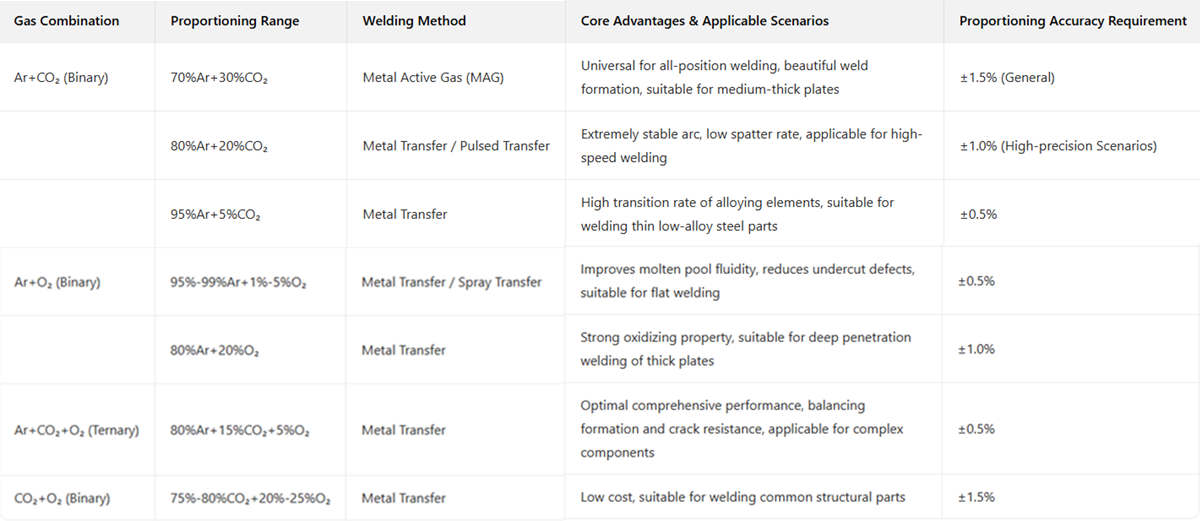
1. Carbon steel and low alloy steel (the most commonly used materials in industry)
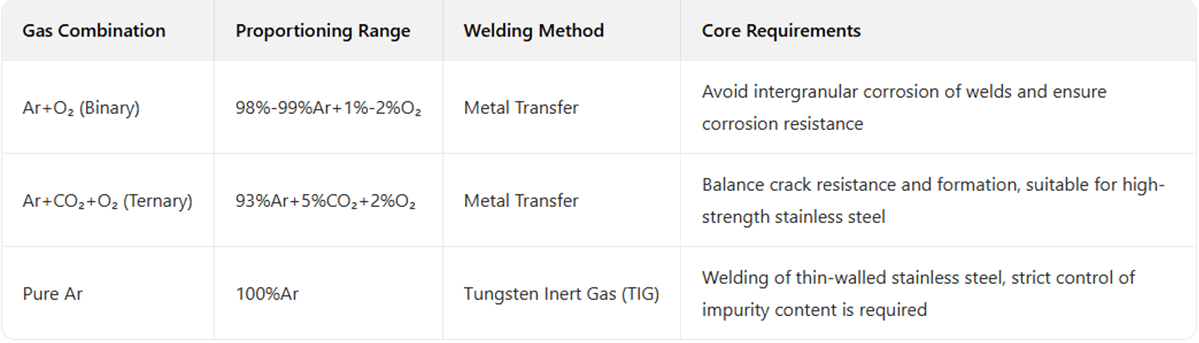
2. Stainless steel and high-strength steel
3. Non-ferrous metals (aluminum, copper, titanium, nickel-based alloys)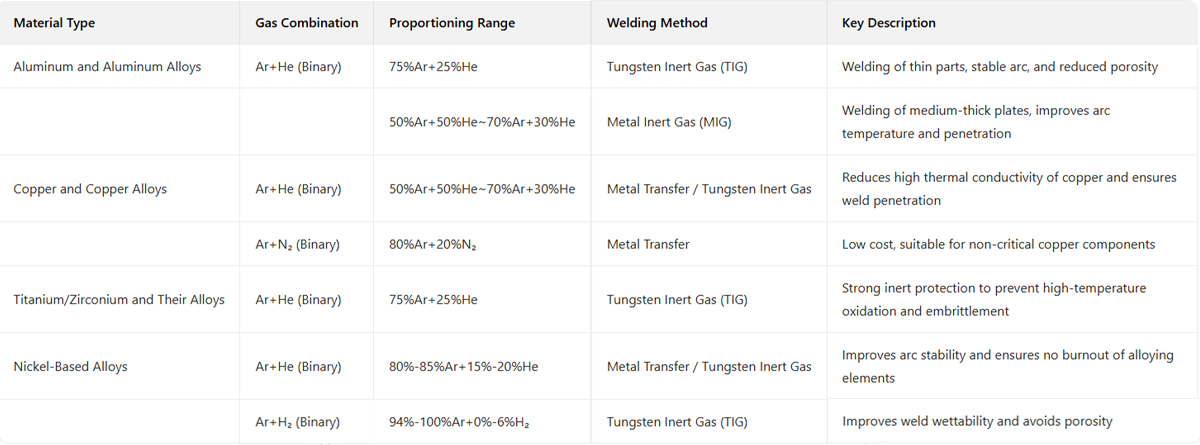
II. Proportioning specifications for other industrial scenarios
1. Food packaging (MAP controlled atmosphere preservation)
2. Electronic/semiconductor manufacturing
III. General Technical Specifications for Proportioning Cabinets (Applicable Across Scenarios)
1. Pressure and flow requirements
• Input pressure: Conventional 0.4-1.0MPa (recommended 0.6±0.1MPa), ensuring that the pressure difference between two/multiple gas sources is ≤0.1MPa to avoid pressure fluctuations affecting the proportioning accuracy;
• Output pressure: 0.2-0.6 MPa (commonly used in welding scenarios is 0.3-0.45 MPa), requiring a pressure regulating valve to maintain stable pressure;
• Flow range: conventional 5-200Nm³/h for binary proportioning cabinet, with a minimum flow rate of ≥8L/min (flow rates below this value may easily lead to proportioning distortion);
2. Mixing accuracy and equipment requirements
• Accuracy level: welding scenario ≥±1.0%, high-precision scenario (electronics/semiconductor) ≥±0.5%, up to PPB level;
• Equipment type:
◦ FIX type (fixed ratio): factory preset ratio to prevent misadjustment, suitable for single working conditions;
◦ FLEX type (adjustable ratio): stepless adjustment, ratio range 5%-92%, with locking function to avoid misoperation;
• Core components: It is necessary to equip with imported gas analysis instruments, high-precision filters (to filter impurities), safety relief valves (for overpressure protection), and components that come into contact with gas should be made of stainless steel to prevent secondary pollution.
3. Safety specifications
• Storage of gases by classification: Oxidizing gases (O₂/CO₂) and reducing gases (H₂) must not be stored in the same cabinet; toxic/flammable gas mixtures (such as PH₃/H₂) require dedicated gas cylinder cabinets equipped with alarm devices;
• Anti-crossflow design: It must feature dual safety measures to prevent the reverse flow of gas from one source in case of an interruption in the other source;
• Environmental requirements: Operating temperature 0-50℃, humidity <80% RH, keep away from open flames and high-temperature sources, ensure good ventilation;
• Operation qualification: Operators must hold a "Container Operation Certificate", and storage tanks must pass inspection and obtain a "Container Use Certificate" before they can be used.
IV. Risk Warning for Violating Proportioning Rules
1. Welding scenario: Excessively high CO₂ content can easily lead to weld porosity and cracks; excessively high O₂ content will exacerbate oxidation and reduce the corrosion resistance of stainless steel; excessively high He content (>50%) can lead to difficulty in arc initiation;
2. Food scene: Insufficient CO₂ content cannot inhibit bacteria, while excessive O₂ content accelerates spoilage;
3. High-pressure scenario: Input pressure exceeding 20MPa is prone to cause equipment damage, and a special explosion-proof design is required when the hydrogen ratio exceeds 6%.